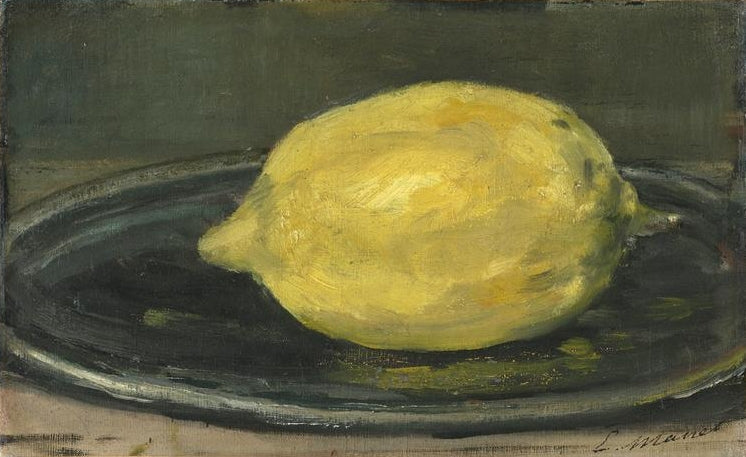
A lemon needs very little help to hold a room. Its colour arrives before its shape: a sharp interruption among wood, stone and pale walls. Set it on a plate and an ingredient becomes a composition.
At Kettle’s Yard in Cambridge, a fresh lemon on a pewter plate forms part of the house’s carefully maintained arrangement. The museum describes its conversation with the yellow in paintings by Joan Miró and Christopher Wood. The fruit is perishable; the relationship is renewed.
That renewal is what makes the detail compelling. A still life usually fixes its subject. Here, the real thing must be replaced. Someone has to notice the lemon, choose another and return it to its place. The arrangement depends on care as much as taste.
It suggests a less ceremonial way of living with beautiful things. A bowl need not wait for a dinner party. A shelf might hold a stone as comfortably as a sculpture. The kitchen already contains a vocabulary of shapes: the swollen curve of citrus, a cut pear, the uneven edge of a loaf.
Try looking at the table before setting it. Notice the colour of the plate against the bread, the height of a jug, the patch of light that will disappear in an hour. A single object, moved a little, can change the whole arrangement.
The lemon will eventually leave the plate. Until then, it offers a small invitation: look again at what is already there.
Read about the house’s arrangements at Kettle’s Yard.
Accompanying image: Édouard Manet, Le Citron, 1880, Musée d’Orsay. Public domain.
All observations ↗